Dink, Drop, Drive: Telling the Three Pickleball Shots Apart
First published October 21, 2026 Last revised October 21, 2026 4-minute read
An article from the La Cuisine en Douceur editorial team.
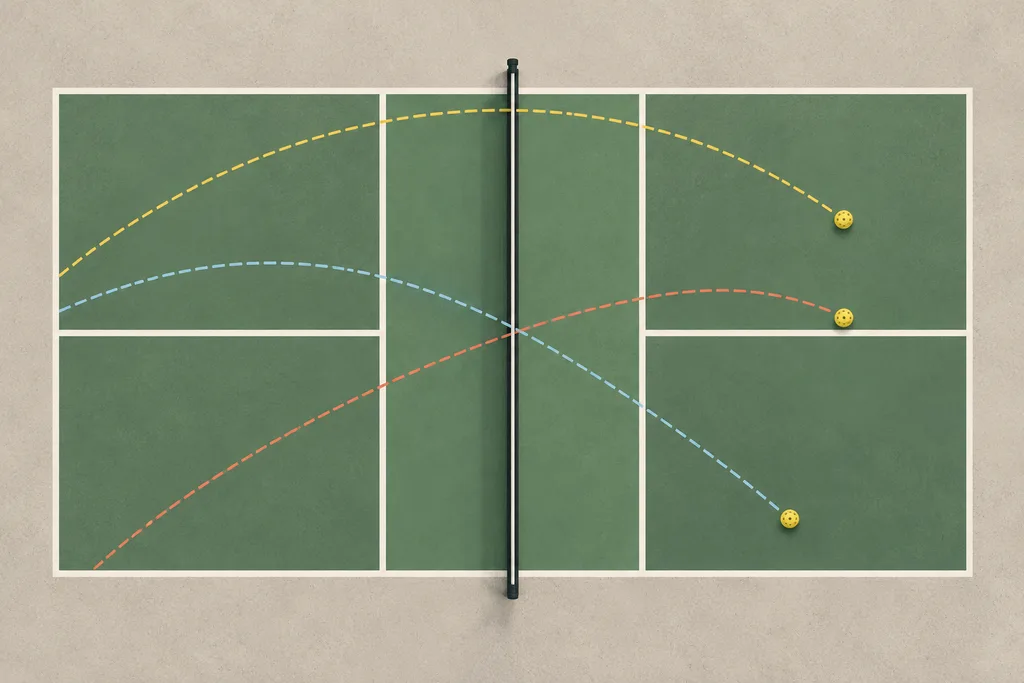
Notepad ready? "Dink, Drop, Drive: Telling the Three Pickleball Shots Apart" starts here. You'll know how to choose between a dink, a drop and a drive based on your position and the ball you receive. We'll cover the terms to keep in mind, what's at stake in the face-off, and what matters when you choose.
The Terms to Keep in Mind
Let's run through the vocabulary.
Double Bounce
The double bounce rule requires the ball to bounce once on each side after the serve before volleys are allowed.
Take this case: the returner lets the serve bounce, then the server lets the return bounce before they can volley.
Keep going with Double Bounce in the glossary.
What's at Stake in the Face-Off
Put this at the center of your thinking: the double bounce rule reduces the advantage of power serves and favors longer rallies, according to USA Pickleball. Read that principle aloud.
Keep this principle in mind: good technique, good footwork and good posture reduce strain on muscles, tendons and ligaments, according to Mass General Brigham.
Keep this principle in mind: USA Pickleball presents the dink as arguably the most fundamental shot in pickleball, because it exploits the non-volley zone rule and produces balls that are generally unattackable.
What Matters When You Choose
Put this at the center of your thinking: the dink relies on a compact, short motion ("less is more") rather than a big swing.
Quick Overview
The markers below deserve your attention.
- For the dink, hold the paddle very loosely — USA Pickleball suggests a grip pressure of about 2 on a scale of 1 to 10.
- On the dink, face the net and move your feet rather than reaching out for the ball.
Danger Zones
The trap here is your momentum: if the follow-through of a volley makes a player touch the non-volley zone (or their partner touches it), it's a fault, even if the ball is already dead.
Your Call
Step to run: at the moment of impact on a dink, the paddle face should be more horizontal than vertical. Repeat it at your own pace.
What's the Difference Between a Dink and a Drop?
Check the following rule: after the serve, the ball must bounce once on each side of the court before players can volley (double bounce rule).
Supporting text: in doubles, the "double chance" applies. Each partner serves before the serve passes to the opponents, except at the very start of the game, when the starting team gets only one chance.
Look where this slides: the FFT describes pickleball as an intergenerational, unifying sport, open to all ages and fitness levels.
When Should You Hit a Drive Instead of a Dink?
What the official text says: in the non-volley zone, volleying is prohibited, including the takeoff and the landing; you can step in to play a ball after it bounces.
End-of-Session Notes
Here are the few notes to keep.
- In doubles, the "double chance" applies.
- For the dink, hold the paddle very loosely.
The Last Word, Plainly
Reread the terms to keep in mind, what's at stake in the face-off, what matters when you choose and the quick overview as needed, in whatever order suits you. Go back over the passages that made you hesitate.
Related articles
- Kitchen Rule in Pickleball: What's Allowed and What Isn't — Non-volley zone, double bounce and related faults. Here: the rules that guide you, the glossary, deeper reading and where to start.
- What Is a Dink in Pickleball? Definition and Role of the Shot — You'll learn to define a dink, know what it's for and spot one in a rally. Topics covered include the essential vocabulary.
- The Double Bounce Rule Explained for Dink Players — You'll learn to apply the double bounce rule on the serve and the return, and understand how it changes your play at the kitchen line.
- Ready Position and Footwork at the Kitchen Line: The Checklist — You'll know how to check your posture and footwork before every dink. Topics covered include the steps to run through and the essential vocabulary.
Sources cited
- What is Pickleball? – USA Pickleball — Overview of the basics: serve, scoring, 7-foot non-volley zone, double bounce rule, origins of the sport. Source last checked on 2026-10-13.
- Pickleball Injuries and Prevention — Common injuries (tendinopathies, sprains, wrist fractures) and prevention tips: dynamic warm-up, equipment, strengthening, technique. Source last checked on 2026-10-13.
- How to Dink and Why It's Important For Your Success in Pickleball – USA Pickleball —
- The Three Ds of Pickleball: Dink, Drop, Drive – Pickleball Canada —
- 2025 USA Pickleball rules, section 9: non-volley zone rules – PlayPickleball —
- Les règles du pickleball — Rules in French: 2.13 m non-volley zone, no volleying in the kitchen, double bounce, serve, scoring, court dimensions. Source last checked on 2026-10-13.
- Pickleball – Le Guide du club — Overview of the sport for clubs: court dimensions, net, equipment, resources and competition guides. Source last checked on 2026-10-13.
The rules cited are based on the text of the Fédération française de tennis, which holds the delegation for pickleball in France, and on those of USA Pickleball; in competition, always check the rulebook in force.
This site doesn't replace the advice of a doctor or a physical therapist: if you have persistent pain in your elbow, shoulder or wrist, see a health professional.