Kitchen Rule in Pickleball: What's Allowed and What Isn't
First published October 21, 2026 Last revised October 21, 2026 4-minute read
An article by the La Cuisine en Douceur editorial team.
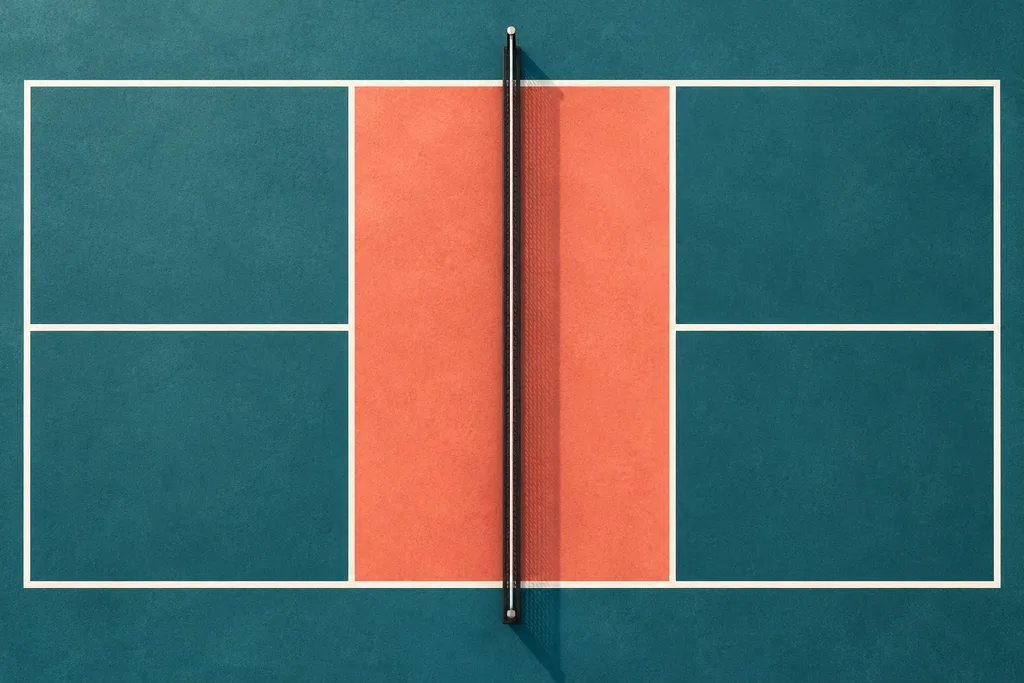
The dink is played within a precise set of rules: volleying is banned in the kitchen. This section draws on the texts of the FFT and USA Pickleball. You're at the entrance to "Rules and Faults."
The Rules That Guide You
Per the rulebook, volleying is banned in the non-volley zone, including the push-off and the landing. You can step in to play a ball after it bounces.
Lock in this rule: the dink relies on a compact, short motion ("less is more") rather than a big swing.
Stick to this line: USA Pickleball calls the dink arguably the most fundamental shot in pickleball, because it exploits the non-volley zone rule and produces balls that are generally unattackable.
Use this as your base: according to USA Pickleball, the double bounce rule reduces the advantage of power serves and encourages longer rallies.
Check the next rule: in doubles, the "double chance" applies. Each partner serves before the serve passes to the opponents, except at the very start of the game, when the starting team gets only one chance.
The Glossary
Tap the word that intrigues you to jump to its definition.
- Double Bounce — the double bounce rule requires the ball to bounce once on each side after the serve before volleys are allowed.
Go Deeper
Browse the articles listed here.
- What Is a Dink in Pickleball? Definition and Role of the Shot — you'll learn to define a dink, say what it's for and spot it in a rally.
- Dink, Drop, Drive: Telling the Three Pickleball Shots Apart — you'll learn to choose between dink, drop and drive based on your position and the ball you get.
- Ready Position and Footwork at the Kitchen Line: The Checklist — you'll learn to check your posture and footwork before every dink.
Start Here
Follow the sequence below.
- At impact on a dink, the paddle face should be closer to horizontal than vertical.
- For the dink, hold the paddle very loosely — USA Pickleball suggests a grip pressure of about 2 on a scale of 1 to 10.
- On a dink, stay facing the net and move your feet rather than stretching your arm to reach the ball.
Side Notes
Look at the history: pickleball was born in 1965 on Bainbridge Island (Washington State). Joel Pritchard, Bill Bell and Barney McCallum came up with it using ping-pong paddles, a perforated ball and a lowered badminton net.
Check the numbers: a pickleball court measures 6.10 m wide by 13.41 m long, which makes four courts on one tennis court, according to the FFT club guide.
Keep this in mind: the FFT presents pickleball as an intergenerational sport that brings people together, open to all ages and fitness levels.
Habits to Drop
Watch out for this trap, the momentum fault: if the momentum of a volley makes a player touch the non-volley zone (or makes their partner touch it), it's a fault, even if the ball is already dead.
Keep Going
Take a moment to read this list.
- The serve must be made below the hip, diagonally, from behind the baseline, and land in the opposite service area.
- After the serve, the ball must bounce once on each side of the court before players can volley (double bounce rule).
- Good technique, footwork and posture reduce the strain on muscles, tendons and ligaments, according to Mass General Brigham.
- The pickleball is made of hollow, perforated plastic (26 to 40 holes, depending on indoor or outdoor use), and the paddle is solid, averaging about 240 g.
Related articles
- What Is a Dink in Pickleball? Definition and Role of the Shot — You'll learn to define a dink, know what it's for and spot one in a rally. Topics covered include the essential vocabulary.
- Dink, Drop, Drive: Telling the Three Pickleball Shots Apart — You'll know how to choose between a dink, a drop and a drive based on your position and the ball you receive. Here are the terms to keep in mind.
- The Double Bounce Rule Explained for Dink Players — You'll learn to apply the double bounce rule on the serve and the return, and understand how it changes your play at the kitchen line.
- Ready Position and Footwork at the Kitchen Line: The Checklist — You'll know how to check your posture and footwork before every dink. Topics covered include the steps to run through and the essential vocabulary.
Sources cited
- Les règles du pickleball — Rules in French: 2.13 m non-volley zone, no volleying in the kitchen, double bounce, serve, scoring, court dimensions. Last visited: 2026-10-13.
- How to Dink and Why It's Important For Your Success in Pickleball – USA Pickleball —
- What is Pickleball? – USA Pickleball — Overview of the basics: serve, scoring, 7 feet non-volley zone, double bounce rule, origins of the sport. Last visited: 2026-10-13.
- The Three Ds of Pickleball: Dink, Drop, Drive – Pickleball Canada —
- 2025 USA Pickleball rules, section 9: non-volley zone rules – PlayPickleball —
- Pickleball – Le Guide du club — Overview of the sport for clubs: court dimensions, net, equipment, resources and competition guides. Last visited: 2026-10-13.
- Pickleball Injuries and Prevention — Common injuries (tendinopathies, sprains, wrist fractures) and prevention tips: dynamic warm-up, equipment, strengthening, technique. Last visited: 2026-10-13.
The rules cited draw on the text of the Fédération française de tennis, which holds the pickleball delegation in France, and on those of USA Pickleball. In competition, always check the current rulebook.
This site is no substitute for the advice of a doctor or physical therapist. If you have lasting pain in your elbow, shoulder or wrist, see a health professional.