Playing the Kitchen: Dink Strategy in Singles and Doubles
First published October 21, 2026 Last revised October 21, 2026 4-minute read
An article by the La Cuisine en Douceur editorial team.
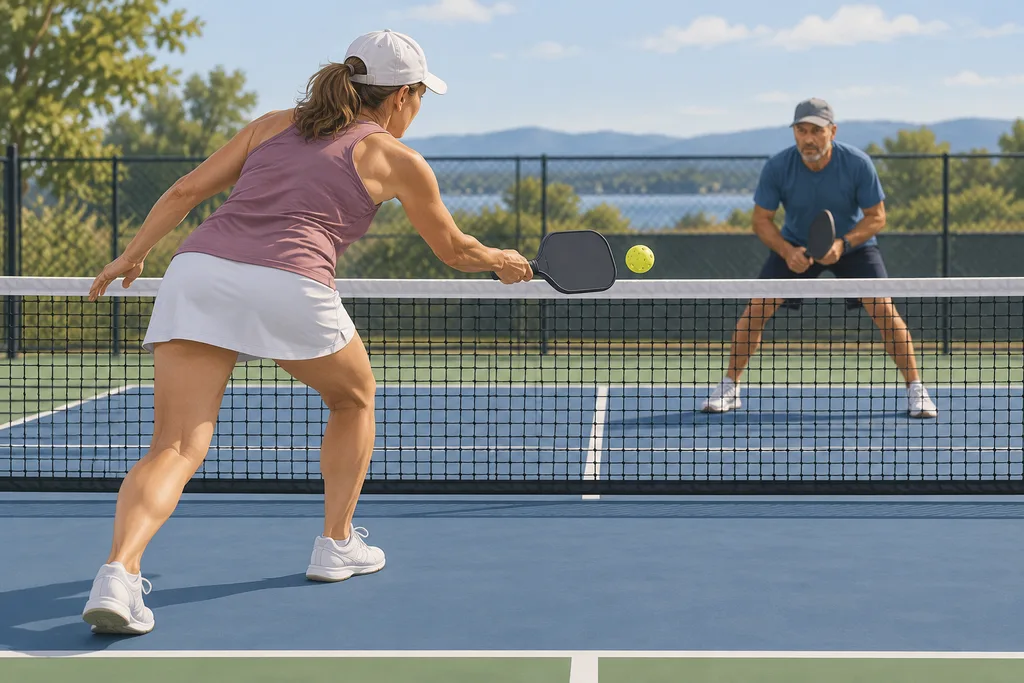
Dink rallies are won with patience and placement. This section helps you pick targets, read your opponent and spot the ball you can attack. It's the starting point for "Kitchen Strategy." Explore at your own pace.
What Holds It All Together
Here's the foundation: the most vulnerable areas in pickleball are the ankle, Achilles tendon, elbow and wrist. Acute injuries (falls, changes of direction) can cause meniscal tears or ACL damage.
Remember this principle: vary your target (forehand, backhand, different spots in the kitchen). It can force your opponent off the kitchen line or make them pop the ball up, which gives you a ball to attack.
The Key Ideas Explained
Read the explanations below closely.
Double Bounce
After the serve, the returning team must let the ball bounce. Then the serving team must do the same on the next shot. Only after that are volleys allowed.
Picture it: the returner lets the serve bounce, then the server lets the return bounce before they can volley. Take this explanation further with Double rebond.
Dig Deeper
Pick the text that fits today's session.
- Où placer ses dinks : cibles et trajectoires pour déstabiliser l'adversaire — you'll learn to choose a target for your dinks and vary the direction to force errors.
Start Here
Work through the list in order.
- On a drop, aiming for the middle of the court is the default choice. It's the lowest part of the net, with a longer kitchen, and it limits your opponents' angles.
- Mass General Brigham recommends warming up with dynamic stretches (heel-to-glute, lunges, upper-body rotations) before you play.
- Varying your dink spots is key — advanced players rarely dink more than 2 or 3 times in a row to the same spot, to break their opponents' rhythm.
- Aim at your opponent's feet and vary your placement. That's Pickleball Canada's advice for drawing errors on the dink.
What Matters When You Decide
Use these markers to choose between your options.
- The cross-court drop clears a relatively low part of the net and has the longest stretch of kitchen, but it's harder for your partner to intercept.
- A drop down the line is the high-risk choice — it clears the highest part of the net and targets the shortest section of the kitchen, but it can put your opponent under pressure.
Side Notes
For the exact numbers, another analysis covering 2013-2022 estimates 77,963 injuries nationwide. Of those, 91% were in players 50 and older, and 83% of injured players were treated and sent home.
By the numbers, in this American study, fractures (32.7%) and sprains/strains (30.8%) are the most common diagnoses. Falls cause 65.5% of injuries.
Keep these figures in mind: in the study, 61.1% of injuries involve players aged 65-80. The average age is 64, and women account for 69.1% of fractures.
Habits to Drop
Fix this one: dinking to the same spot again and again helps your opponent find their rhythm.
Keep Going
The figures below deserve your attention.
- The most affected body parts are the wrist (12.7%), lower trunk, lower leg, head (11.3%) and knee (7.0%) in the cases studied from 2013 to 2022.
- Pickleball injuries in US emergency departments rose 22-fold between 2013 (611 cases) and 2022 (13,690 cases), according to a study covering 2013-2022.
Related articles
- Where to Place Your Dinks: Targets and Trajectories to Unsettle Your Opponent — You'll know how to pick a target for your dinks and vary directions to create errors. Topics covered include the terms to keep in mind.
- Seven Stroke Mistakes That Ruin Your Dinks — You'll learn to spot and fix the most common dink stroke flaws. Inside: what to understand first and what to watch closely.
- Nailing the Dink Motion: Paddle Grip, Swing and Touch — You'll learn to hit a short, controlled dink with a relaxed grip and a shortened swing. Inside: the method's principle and the terms used here.
- Kitchen Rule in Pickleball: What's Allowed and What Isn't — Non-volley zone, double bounce and related faults. Here: the rules that guide you, the glossary, deeper reading and where to start.
Sources cited
- Pickleball Injuries and Prevention — Common injuries (tendinopathies, sprains, wrist fractures) and prevention tips: dynamic warm-up, equipment, strengthening, technique. Page checked on 2026-10-13.
- How to Dink and Why It's Important For Your Success in Pickleball – USA Pickleball —
- Where to hit your drops – USA Pickleball —
- The Three Ds of Pickleball: Dink, Drop, Drive – Pickleball Canada —
- Rising orthopedic injuries in pickleball: insights from a 10-year national study — Summary of a study on pickleball-related orthopedic injuries between 2013 and 2022: fractures, sprains, wrist, players 50 and older. Page checked on 2026-10-13.
- Increasing Incidence of Pickleball Injuries Presenting to US Emergency Departments — 10-year analysis of pickleball injuries in US emergency departments: falls, fractures, wrist, age of injured players. Page checked on 2026-10-13.
The rules cited draw on the text of the Fédération française de tennis, which holds the delegation for pickleball in France, and on those of USA Pickleball. In competition, always check the current rulebook.
This site doesn't replace the advice of a doctor or physical therapist. If you have persistent pain in your elbow, shoulder or wrist, see a health professional.